

 get a quote
Should You Invest in Plastic or Phenolic Partitions?
Table of Contents:
- What Is Phenolic Resin Material?
- What Is Plastic Laminate?
- Plastic Laminate vs Phenolic Bathroom Partitions: Side-by-Side Comparison
- So, Which Is Best for Your Commercial Bathrooms?
- One Point Partitions Can Help With Both
When it comes to commercial bathroom partitions, phenolic resin and plastic laminate are some of the most popular materials. But which one is right for you?
The material you pick can be the difference between restroom stalls that last decades and ones that need replacing after only a few years. And besides aesthetics, it’ll also determine how much you’ll spend on partitions and how often you’ll have to fix or replace parts down the line.
To help you choose the most suitable material for your commercial bathrooms, we’ve compared phenolic vs plastic partitions side by side. Understanding their composition and advantages will help you decide which is right for your business.
What Is Phenolic Resin Material?
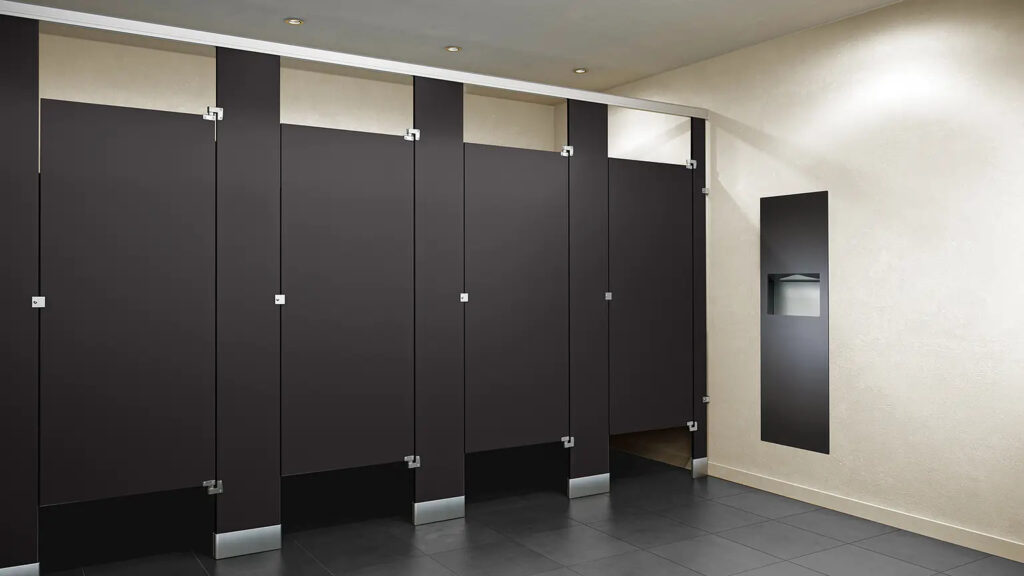
Phenolic resin is a liquid that contains two chemicals (phenol and formaldehyde). Once heated and pressed together with the core of a bathroom partition, they form a rigid material that won’t bend, melt, soften, or warp easily, even in high heat or humidity.
Phenolic bathroom partitions are made by stacking multiple sheets of kraft paper — a strong, coarse paper produced from wood pulp — until they reach the desired thickness. That stack is then soaked in phenolic resin. Next, decorative sheets are added to the top and bottom of the stack to achieve a particular color or pattern.
After that, the whole stack is pressed under high heat and pressure, which cures the resin and turns the layers into a rigid, completely non-porous panel. Finally, the edges are sealed through a process called edge banding. This prevents moisture from seeping into the partition.
Because of their rigid core and long lifespan, phenolic partitions are common in high-traffic or humid environments, such as gyms, pools, schools, airports, and stadiums.
The Benefits of Phenolic Partitions
Why is phenolic plastic material common in commercial bathroom partitions?
- Moisture resistance: Since phenolic partitions are non-porous and sealed at the edges, they resist moisture. They won’t swell, warp, or fall apart in high-humidity restrooms or with repeated cleaning.
- Graffiti resistance: The non-porous nature of phenolic partitions prevents liquids from penetrating or sticking firmly to the core. That means markings made with paint or ink will sit on the surface rather than soak in. As a result, you can easily remove graffiti using common commercial cleaners without damaging the panel.
- Impact durability: Phenolic partitions are designed to be tough, making them highly resistant to vandalism. Their sturdy core can resist scratches and handle strong bumps without cracking or denting. With proper maintenance, phenolic partitions can retain their structure for decades. They can last up to 25 years.
- Multiple aesthetic options: Phenolic partitions come in many colors and finishes. One Point Partitions offers them in 13 different colors, including black, silver, gray, and white.
- Sustainability: Because phenolic bathroom dividers are long-lasting, you don’t have to replace them often. The result? Reduced waste and resource consumption. On top of that, the partitions’ core material (kraft paper) can be made from recycled content, reducing the need for virgin paper and lowering the overall environmental impact.
What Is Plastic Laminate?
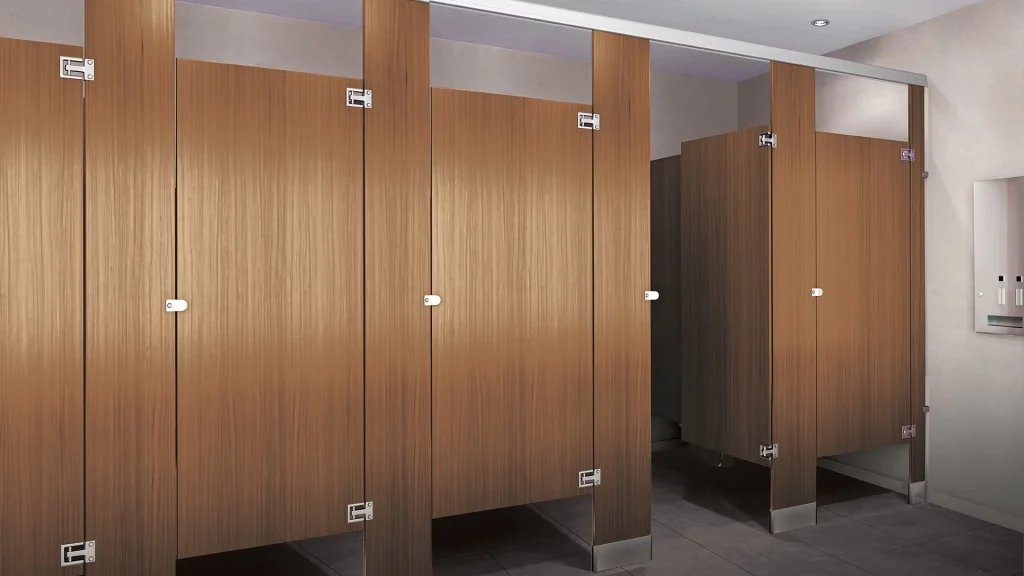
Plastic laminate is a decorative veneer made by combining paper layers with resin under heat and pressure. The result is a hard, smooth surface that can be produced in a wide range of colors and patterns.
To make plastic laminate partitions, manufacturers first prepare a core, usually an engineered wood product called particleboard. The core determines the thickness, structure, and strength of the partitions.
Using strong adhesives, decorative plastic laminate sheets are then glued to the front and back surfaces of the particleboard. This usually happens under high pressure to bond the laminate firmly to the core, creating a solid panel. The panel’s edges are then sealed to protect the core from moisture.
Plastic laminate bathroom partitions are common in offices, small businesses, and other low-traffic facilities because they are budget-friendly and available in a variety of designs.
The Benefits of Plastic Partitions
Plastic laminate partitions are a popular choice for commercial restrooms for several reasons.
- Cost-effectiveness: The cost of bathroom partitions varies among sellers. But, in general, plastic laminate partitions are less expensive upfront than phenolic.
- Design flexibility: Because decorative plastic laminate comes in a wide range of colors, it’s easy to match partitions to your bathroom’s overall style. Whether you want sleek tones to complement a modern restroom or bold colors that make a statement, you’ll find a finish that fits your space.
- Lightweight: Plastic partitions’ particleboard core makes them easy to transport and move around during installation.
- Suitable for low-moisture environments: For many small businesses, the low-impact traffic in their restrooms means a low-moisture environment. This lets those business owners take advantage of the other benefits of plastic partitions.
Plastic Laminate vs Phenolic Bathroom Partitions: Side-by-Side Comparison
Phenolic vs plastic partitions: how do they compare?
| Feature | Phenolic | Plastic Laminate |
| Core and Construction | Multiple sheets of kraft paper saturated with phenolic resin, which creates a waterproof material when heated under pressure. | Particleboard core bonded with decorative plastic laminate sheets. |
| Moisture Resistance | Highly resistant. The treatment makes the entire thickness of the material completely non-porous. | Poor. Only the decorative surface is treated with resin, so the core can easily absorb moisture when exposed. |
| Damage Resistance | Dense, hard surface excellently resists dents, chips, and scratches. | Core swells and peels easily when exposed to moisture; the decorative surface is more vulnerable to chipping and scratches. |
| Durability | Very long (often over two decades) when installed and maintained properly. | Shorter lifespan, since it’s less resistant to damage and moisture. |
| Maintenance and cleanliness | Non-porous surface makes it graffiti-resistant and easy to clean. | Cleaning can potentially dull the decorative sheet and damage the core. Graffiti ink may penetrate the surface layer, making it harder to remove. |
| Upfront Cost | High. | Low. |
| Cost Over Time | Low (longer lifespan reduces replacement costs, and less frequent repairs minimize maintenance expenses). | High (shorter lifespan increases replacement expenses, while poor damage resistance increases repair costs). |
| Aesthetics | Wide range of colors, finishes, and textures. | An even broader range of colors, finishes, and textures. |
| Sustainability | Longer lifespan reduces waste and replacement frequency. | Shorter lifespan increases waste and replacement frequency. |
| Typical Application | High-traffic restrooms, such as in schools, airports, pools, and gyms. | Low-traffic or controlled restrooms, such as in offices, small businesses, and retail stores. |
So, Which Is Best for Your Commercial Bathrooms?
Choosing between phenolic and plastic laminate comes down to how your restroom will actually be used.
Are you expecting high humidity, heavy traffic, frequent cleaning, or occasional vandalism in your commercial bathroom? Phenolic is the most suitable in that case. Its dense, resin-filled core makes it highly resistant to moisture and vandalism, and it stays looking good for years with minimal upkeep.
But if your restroom is in a controlled, low-traffic environment and your priorities are budget and aesthetics, plastic laminate can absolutely get the job done. It costs less upfront and comes in a wide range of finishes, making it an excellent choice for restrooms that don’t experience a ton of traffic.
However, don’t choose partitions based solely on the initial price tag. Phenolic often delivers better value over time because it lasts longer and needs fewer repairs or replacements. Think about the total lifecycle cost and the day-to-day conditions your partitions will face before making your final decision.
One Point Partitions Can Help With Both

One Point Partitions is a U.S.-based supplier of commercial toilet dividers. Whether you’re looking for phenolic partitions that can last for years without swelling or affordable plastic laminate bathroom dividers that won’t break the bank, we can help you find an ideal fit for your restroom.
If you’d like to consider more options before making the final decision on partition material, we also offer powder-coated steel, solid plastic, and stainless steel bathroom partitions.
Get a free custom quote today so you can plan, budget, and bring your ideal bathroom design to life as quickly as possible.