

 get a quote
ADA Compliant Bathroom Design: An Inclusive and Safe Commercial Restroom Checklist
Table of Contents:
- Inclusive Restroom Design in ADA-Compliant Commercial Bathrooms
- Commercial Bathroom Requirements for ADA Compliant Design
- Restroom Privacy Partitions in ADA-Compliant Commercial Bathrooms
- Gender Neutral Commercial Restroom Layouts That Support User Privacy
- Material and Safety Considerations for Inclusive Commercial Restrooms
- Commercial Bathroom Design Checklist: Accessibility, Privacy, and Safety
- Build an ADA-Compliant and Inclusive Restroom With One Point Partitions
An ADA-compliant bathroom design helps you get the basics right.
Instead of treating accessibility, privacy, and inclusivity as optional upgrades, it considers them essential requirements for complying with the Americans with Disabilities Act (ADA), which sets standards for accessible bathrooms.
To help facility managers, business decision-makers, and property managers understand the standards for accessible restrooms, this guide provides a checklist of commercial bathroom requirements for ADA compliance.
Inclusive Restroom Design in ADA-Compliant Commercial Bathrooms
An inclusive restroom design makes the bathroom accessible for all users, including people with disabilities.
An inclusive restroom prioritizes:
- Privacy with layouts and stalls that prevent exposure
- Dignity and usability are ensured by accessibility features integrated seamlessly into the design, which enable people with disabilities to use the bathroom independently and safely
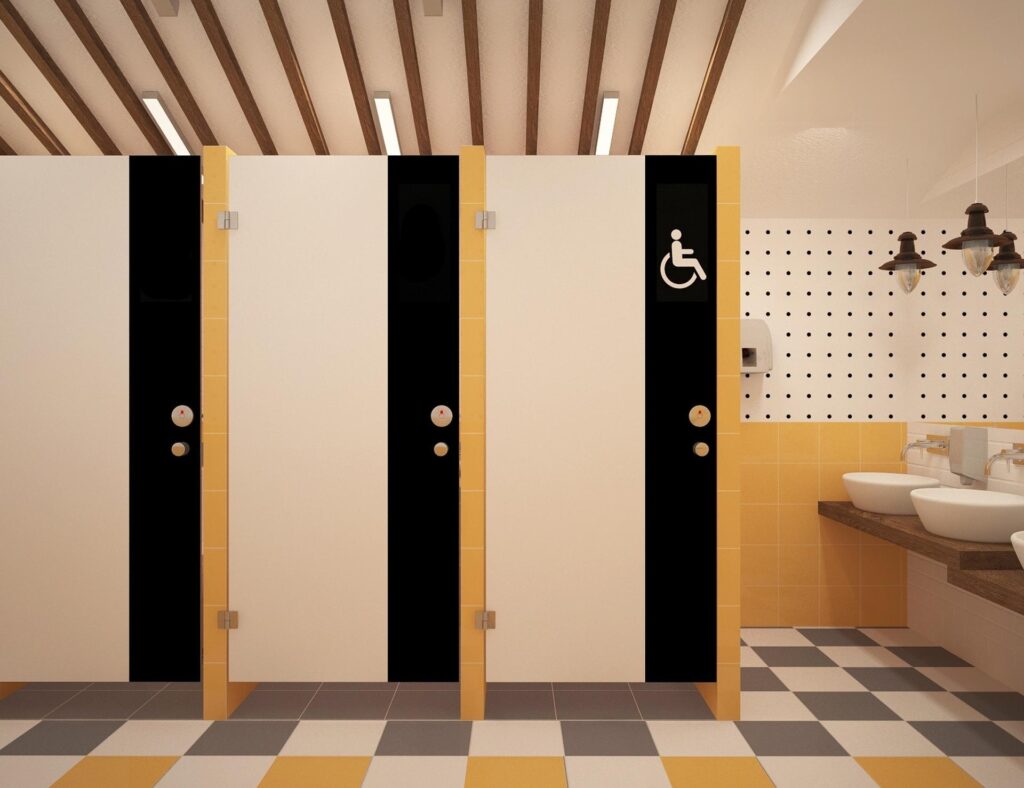
Growing Focus on Accessibility and Safety
Accessibility and safety expectations have steadily increased across commercial facilities as more organizations recognize their responsibility to create spaces that are usable and comfortable for everyone.
This shift is also driven by stronger regulatory oversight and greater public awareness. ADA compliance is a legal requirement and a critical part of risk management. Inaccessible or unsafe restrooms expose facilities to lawsuits and fines. They may also ruin a brand’s reputation, making compliance essential for long-term operational stability.
Safety and accessibility are closely connected in restroom design. Features that improve safety also make restrooms more accessible. For example, proper clearances allow wheelchair users to navigate safely.
New Expectations Around Privacy in Public Restrooms
In commercial bathrooms, users across all groups expect privacy the minute they close the stall door behind them.
Yet, many Americans still feel like public restrooms aren’t private enough. In a 2025 survey, 72% said that public restroom stalls lack sufficient “coverage.” Over 50% would like the gaps around stall doors and walls eliminated.
And as gender-neutral commercial restrooms become more popular, the demand for privacy is likely to continue rising.
Privacy in ADA-compliant bathroom design promotes inclusion. People with disabilities may already feel vulnerable in public due to accessibility challenges. The assurance of a private bathroom space that’s comfortable and safe to use may help eliminate their reluctance to use public facilities.
Nowadays, privacy is a key part of ADA-compliant bathroom design, helping protect every user’s dignity and prevent uncomfortable or embarrassing moments.
How These Changes Impact Restroom Layout and Planning
The growing focus on accessibility and the new expectations around privacy influence stall layout, spacing, and traffic flow. For example:
- Toilet stalls in commercial bathrooms are typically positioned away from the main entrance, so people walking by or entering the restroom can’t see directly into a stall.
- Stall doors have latches to prevent accidental entry into an occupied toilet compartment.
- ADA-compliant bathroom design must include sufficient clearance within toilet compartments to accommodate people with disabilities.
Since ADA compliance, privacy, and inclusivity are inherently connected, it’s best to plan for them together when designing your commercial bathroom, rather than separately. That way, you can make the right layout decisions from the very beginning, which prevents expensive retrofits later.
Commercial Bathroom Requirements for ADA Compliant Design
To design a compliant bathroom, use ADA standards for layout, fixture placement, and partitions. This section clearly breaks down the requirements in an easy-to-understand, easy-to-implement way.
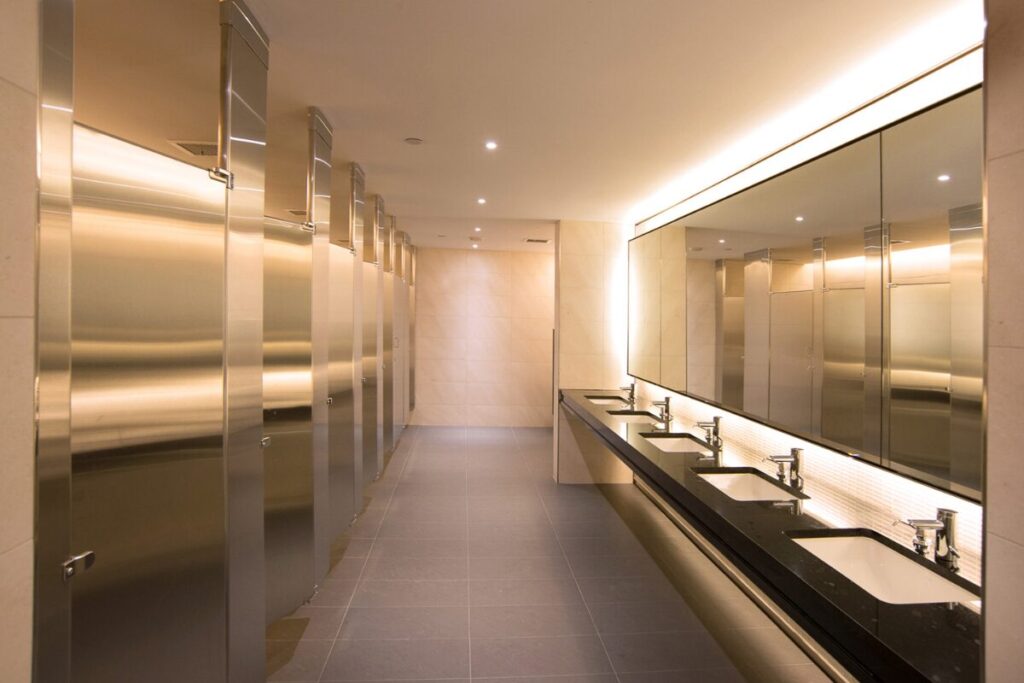
Required Stall Dimensions and Clearances
If your commercial bathroom contains two or more toilet compartments, at least one must comply with ADA requirements. The minimum width of a standard ADA-compliant stall is 60 inches.
The depth of the stall, measured from the back wall to the front partition, depends on how the water closet (the bowl, seat, and flushing mechanism) is mounted. A wall-mounted toilet requires at least 56 inches of depth, while a floor-mounted toilet requires at least 59 inches.
The distance from the centerline of the water closet to one of the stall’s side walls must be at least 18 inches, leaving a clear floor space within the compartment.
These dimensions provide enough space for a person using a wheelchair to enter the stall, comfortably position themselves, and transfer safely onto the toilet. No other bathroom plumbing fixture, other than the water closet, can be located within the minimum stall space required.
Door Widths, Hardware Placement, and Turning Radius
An ADA-compliant toilet stall must have a door opening of at least 32 inches, which is wide enough to allow wheelchair access. That opening should start no more than four inches from the side partitions farthest from the water closet.
Stall doors can’t swing into the minimum stall area to avoid obstructing the clear floor space that people with wheelchairs use to maneuver. They should be self-closing, and opening them shouldn’t require more than five pounds of force.
On top of that, ADA requires door pulls on both sides, and they should be placed between 34 and 48 inches above the finished floor. Each pull must provide at least 1.5 inches of knuckle clearance for gripping.
Door pulls and latches should be operable with one hand and not require a tight grasp or twisting.
Within the commercial restroom but outside the stalls, there should be a circular turning space (60 inches in diameter) that makes it easy for people with disabilities to maneuver. The restroom door can swing into the turning space.
Partition Positioning for ADA Accessible Stalls
Where you place bathroom partitions determines the clear floor space inside toilet stalls. To stay compliant, make sure their width and length meet the ADA’s minimum dimensions for a bathroom compartment.
Toe clearance around bathroom partitions matters, too. ADA guidelines require at least nine inches of clear space from the floor to the bottom of the front partition (including the door) and one side partition. This gap must extend at least six inches deep so someone using a wheelchair can slide their footrests underneath.
When designing an ADA-compliant bathroom, plan the layout of partitions and bathroom fixtures together. That’s because ADA standards are based on how bathroom elements relate to each other. For example, the centerline of the toilet must be 18 inches from one side partition. Moving the side panel by even a few inches can render the toilet’s position noncompliant.
Restroom Privacy Partitions in ADA-Compliant Commercial Bathrooms
You can maximize privacy while maintaining an ADA-compliant bathroom design with high-privacy partitions. With them, you make privacy upgrades without compromising safety or access.
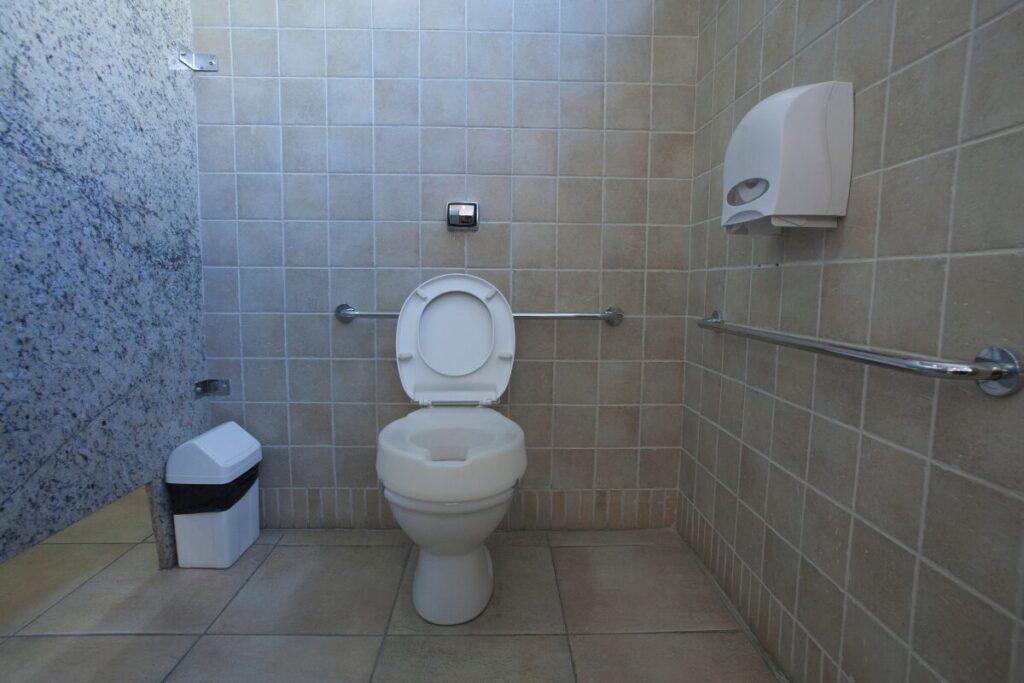
Taller and Deeper Partition Options
In many traditional ADA-compliant bathrooms, there’s a lot of open space under the stall doors and along the side panels (for toe clearance). And because the partitions usually don’t reach the ceiling either, the stalls can feel more exposed than many people are comfortable with.
Full-height or floor-to-ceiling toilet partitions can solve this problem by eliminating those spaces, creating a high-privacy design. They are common in offices, hospitality, and public facilities.
The best part is that you use them and still comply with ADA’s toe clearance standards, even without spaces beneath the partitions.
That’s because when a toilet compartment exceeds the standard stall dimensions by a specific number of inches, the ADA no longer requires toe clearance. For wall-hung toilets, the stall must be at least 62 inches deep. For floor-mounted toilets, it must be at least 65 inches deep. In either toilet mounting setup, the compartment must be wider than 66 inches to eliminate the need for toe clearance.
Reducing Sightlines and Eliminating Gaps
Gaps between partition panels and doors leave peeping spaces that raise privacy concerns in commercial bathrooms.
Zero-sightline toilet partitions feature a flush-fit, continuous-edge design that ensures joints between panels and doors are gap-free, reducing the risk of exposure. This improves inclusivity by ensuring comprehensive privacy for all users.
Privacy Solutions for High-Traffic and Multi-User Restrooms
High-traffic and multi-user restrooms face unique privacy challenges. With multiple people visiting the restroom at once, there’s a high risk that many users will feel uncomfortable if the right privacy measures aren’t in place.
Consider using:
- Full-height, no-sightline partitions
- Strategic bathroom layouts that ensure stalls aren’t in direct view of the main entrance
Remember to balance privacy and ADA-compliance with durability. Choose partitions that can withstand constant physical impact, frequent cleaning, and potential vandalism common in high-traffic restrooms.
Gender Neutral Commercial Restroom Layouts That Support User Privacy
Gender-neutral or unisex stalls are popular in ADA-compliant bathrooms because they’re more inclusive. For example, people who use personal care assistants of the opposite sex in the bathroom can access unisex toilets without any awkwardness. With a privacy-focused design, you can provide a dignified experience for every user, regardless of their gender.
If you’re renovating an existing building and it’s technically impossible to make existing toilet rooms fully ADA-compliant, you can install an accessible unisex toilet room as a substitute.
Single User vs. Multi-Stall Layout Options
In an ADA-compliant bathroom design, gender-neutral commercial restrooms can be either single-user rooms or multi-stall spaces.
Single-user toilet rooms are fully enclosed, lockable rooms designed for one person at a time, making them most appropriate in low-traffic restrooms. They are usually entered directly from a shared corridor or an exterior walkway. For ADA compliance, each single-user unisex bathroom must include a privacy latch and no more than one sink, one water closet, and one urinal. If two or more single-user toilets are next to or close to one another, 50% of them must be ADA-compliant.
A multi-stall gender-neutral commercial restroom, on the other hand, is one room with multiple toilet compartments. This enables two or more people to use the bathroom simultaneously, making multi-stall restrooms most appropriate in high-traffic premises. In each compartment, partitions surround a water closet. At least one stall in the bathroom must be wheelchair accessible to comply with ADA requirements.
Full Height Partitions for Added Comfort and Safety
Partitions in multi-stall gender-neutral restrooms can leave spaces underneath for toe clearance, or they can be full-height (running from the floor to the ceiling).
Full-height partitions offer the highest level of privacy because they eliminate gaps at the floor and ceiling. That’s why they’re common in schools, hotels, and airports. However, to stay ADA-compliant, these fully enclosed stalls must meet the minimum dimensions required for toilet compartments without toe clearance.
Because fully enclosed stalls don’t leave an opening at the top, it can be harder to reach someone who needs urgent help. If you use them, consider safety features like emergency-release door locks that allow emergency access from outside the stall.
Considerations for Signage, Wayfinding, and Traffic Flow
Clear signage, whether it provides direction or identifies a particular restroom, makes it easy for everyone to find a bathroom that meets their needs. They also prevent the embarrassment of entering the wrong restroom.
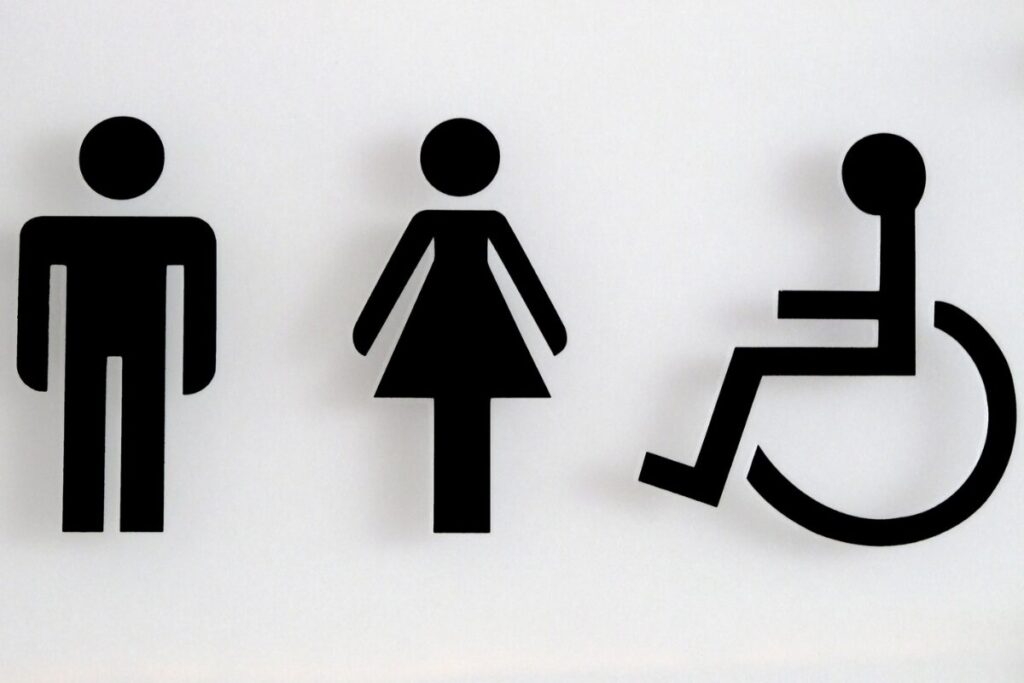
If you use symbols for women’s, men’s, or gender-neutral restrooms, ADA standards require you to include the written label below in raised characters and braille. And if not all restrooms are accessible, the accessible one must be marked with the International Symbol of Accessibility (ISA).
The ADA stall will probably be the largest one in your restroom. Strategically place it at the far end (away from the entrance). If you place it near the entrance, its wide outward-swinging door can disrupt traffic when someone opens or closes it. This can cause congestion and even accidents in the hallway.
Material and Safety Considerations for Inclusive Commercial Restrooms
The materials you choose impact safety, durability, maintenance, and compliance in your bathroom. For example, your flooring affects slip resistance.
Meanwhile, some partition materials are easier to clean than others and can maintain their structural integrity longer (even in high-use environments) to keep your restroom ADA-compliant for many years.
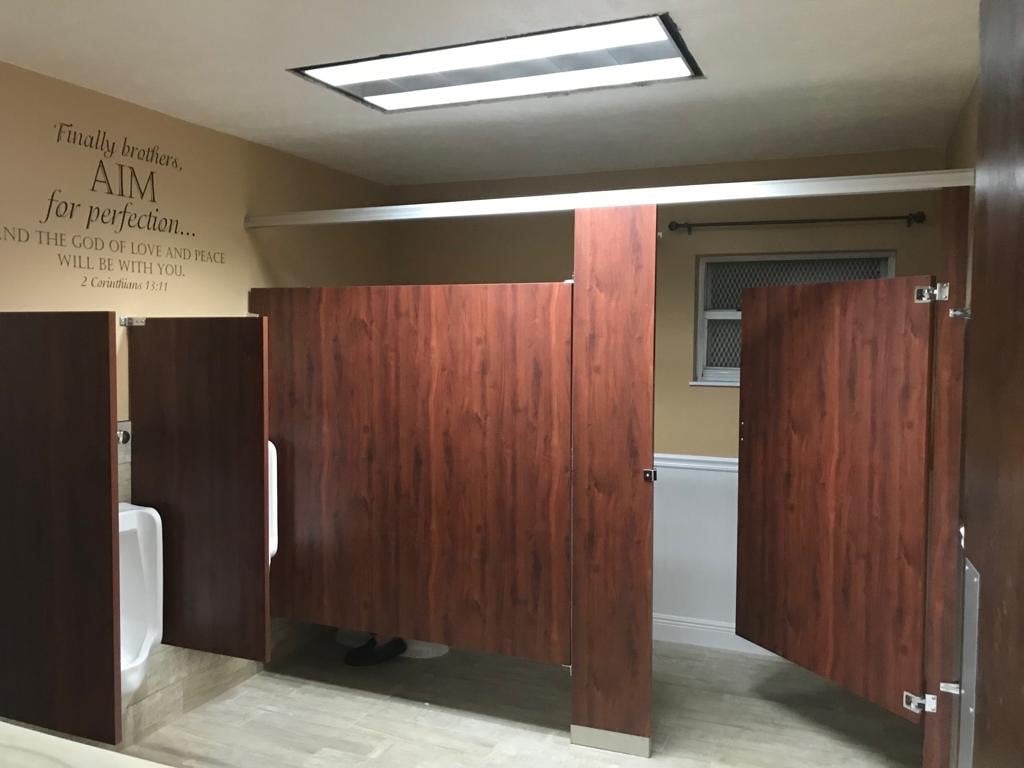
Durable Partition Materials for High-Use Facilities
If you use durable materials in your ADA-compliant bathroom design, your toilet stalls can last for decades without needing replacements or renovations.
Long-lasting partitions for high-traffic restrooms can withstand constant impact and resist high moisture without warping or rusting. They’re vandalism-resistant, too. Popular and durable material options for high-use facilities include solid plastic, phenolic, and stainless steel.
Surface Cleanability and Moisture Resistance
Easy-to-clean partition materials, such as stainless steel, make daily maintenance easier. When stalls are quick to wipe down and disinfect, it’s easier to meet hygiene standards and create a restroom that feels safe and welcoming for everyone.
You also want the partitions to be moisture-resistant. This prevents water from soaking into the material during regular cleaning, which helps avoid warping, swelling, and long-term damage. That matters for ADA compliance because warped panels and doors can mess up stall dimensions over time.
Another critical consideration is that different partition materials come with different care requirements. Knowing how to properly clean and maintain each type can help extend their lifespan and preserve their appearance for the long run.
Slip Resistance, Lighting, and Emergency Access
To reduce the risk of slips and falls, use slip-resistant flooring in your bathroom. For commercial restrooms, materials with an R10 or R11 slip-resistance rating are usually the go-to choice because they provide sufficient grip.
Good lighting is also important. A well-lit restroom helps people see and avoid wet spots, which are among the most common causes of slip-and-fall accidents.
In the event a user falls or becomes incapacitated inside an accessible toilet room or compartment, it should be easy to reach them to offer aid. Emergency access that could be helpful includes:
- A stall door with an emergency release mechanism that ensures the door can be opened safely from the outside
- Emergency call buttons or pull cords that are easily reachable from the floor.
All these elements work together to ensure everyone can safely access commercial bathrooms.
Commercial Bathroom Design Checklist: Accessibility, Privacy, and Safety
Do you want your bathroom design to comply with ADA requirements while maximizing safety and privacy? The following checklists can help:
Layout and ADA Requirements Checklist
| Bathroom Feature | ADA Compliance Requirement |
| Stall dimension | – Minimum width: 60 inches
– Minimum depth (Wall-mounted toilet): 56 inches – Minimum depth (Floor-mounted toilet): 59 inches |
| Distance from the water closet to one side of the partitions | – 18 inches |
| Grab bars inside the stall | – A 36-inch grab bar behind the water closet (one end no farther than 6 inches from the inside corner of the stall)
– Another grab bar at the side wall nearest to the water closet: starts within 12 inches of the back wall and extends forward so that it reaches at least 52 inches from the back wall |
| Toe clearance underneath the front and one stall partition | – Floor to bottom of partition: at least nine inches
– Depth: six inches minimum |
| Door opening width | – At least 32 inches |
| Circular turning space inside the restroom (not stall) | – 60 inches in diameter |
Common mistakes to avoid include:
- Door swinging into the minimum required stall space: make it swing outward instead of inward.
- Placing the stall door directly facing the toilet: Offset the door to the front end that doesn’t face the water closet
Privacy and Partitions Upgrades Checklist
Restroom privacy partitions (e.g., floor-to-ceiling) can help you maximize privacy. But because there won’t be toe clearance, you’ll need to enlarge the stall dimensions to comply with ADA.
| Full- or extended-height partitions with no toe clearance | Adjusted ADA stall dimensions |
| Wall-hung toilet stall | 62 inches deep, 66 inches wide |
| Floor-mounted toilet stall | 65 inches deep, 66 inches wide |
Other privacy upgrades include:
- Overlapping or interlocking door edges for zero-sightline design
- Secure, easy-to-operate privacy latches
Safety, Materials, and Maintenance Checklist
For a safety-focused design, use:
- Slip-resistant flooring
- Even floor transitions to avoid tripping hazards
- Bright lighting in the restroom
And when choosing a partition material for long-term compliance, make sure it’s moisture- and impact-resistant. It should also be easy to clean.
Build an ADA-Compliant and Inclusive Restroom With One Point Partitions
ADA-compliant bathroom design ensures your restroom is accessible to everyone, including those with disabilities. It also eliminates the risk of lawsuits and noncompliance fines.
Durable partitions from a reliable seller like One Points Partitions can help you build a restroom that stays compliant in the long term. Talk with a partition expert and see how we help you get compliant bathroom dividers.